- Steve Xu steve01@aikunpower.com
Table of Contents
With the mature development of lithium ion technology, lithium batteries are now widely applied for energy storage, electric power and many other projects, especially the 48V lithium iron phosphate battery(LiFePO4 Battery) is the most popular choice for people now.Then, choosing the right 48V lithium battery becomes vitally important for your project’s success. This post will guide you through the most important steps of making the right choice.
1. To Figure out Requirements of Battery Applications
You should make clear of the battery applications:like solar energy storage or motive power? Different applications have different requirements about the battery:including cells parameter, BMS parameters and structure design.
1.1 For Residential Solar System
First step, to calculate the daily power consumption in watt-hour;
Second step, choose the battery capacity that meets your demand: eg. a 48V 100Ah Lithium Battery can supply 4000w AC loads for one hour after charged for off-grid solar system.
Here’s a simple table that outlines selecting battery capacity, inverter power, and solar panels based on daily power consumption(you can directly check out the electricity bill) :
Battery Capacity | Inverter Power | Solar Panel |
6.25 kWh | 1.5 kW | 1.2 – 1.5 kW |
12.5 kWh | 3 kW | 2.4 – 3 kW |
18.75 kWh | 4.5 kW | 3.6 – 4.5 kW |
Notes:
Battery capacity: normally depth of discharging regarded as 80%(DOD 80%);
Inverter power: recommend inverter power 1.5 times of peak loads;
Solar panel: rough estimate of 4-5 hours effective sunlight/day, accurate needs will be checked by location, panel efficiency, weather conditions.
1.2 For UPS
Firstly, to calculate the total power of your load;
Second, how long you need the UPS to operate during the power outage:
Battery Capacity (Ah)= (Total Load Power*Desired Runtime in Hour)/Voltage 48V/0.8DOD
And batteries’ designed cycle life also matters for long-term operation.
1.3 For Motive Power Supply
To choose 48v lithium batteries for different electric vehicles, the desired running range and motor power is vitally important.
The table below listed 48V battery capacities according to different motor power and desired running ranges. The values may vary by specific models and working conditions.
Vehicle Type | Motor Power | Desired Range | Battery Capacity | Battery Capacity |
Electric Bike | 250-750 W | 20-40miles | 10-20Ah | 0.48 – 0.96kWh |
Electric Scooter | 500-1500 W | 25-50miles | 15-30Ah | 0.72 – 1.44kWh |
Three-Wheeler | 1000-3000 W | 40-60miles | 20-40Ah | 0.96 – 1.92kWh |
Golf Cart | 1000-3000 W | 30-50miles | 30-50Ah | 1.44 – 2.4kWh |
RV | 2000-5000 W | 50-100miles | 40-100Ah | 1.92 – 4.8kWh |
Yacht | 3000-8000 W | 20-60miles | 50-100Ah | 2.4 – 4.8kWh |
2. How to Choose the Right 48V Lithium Battery
Based on the application requirements, you can now come to a general conclusion about battery capacity, working current, max discharging time, suitable battery dimension and ideal structure design.
2.1 To Check out Battery Capacity
From the average loading power and discharging time, you can easily calculate the total power required by formula: Loading Power*Running Time; then use another formula to get the capacity which is workable for your application: Total Power/48V/0.8(under conditions of DOD 80%, system voltage 48V); to this point, you get the ideal capacity of the battery.
2.2 Make Clear of BMS Requirements
Battery management system(known as BMS) plays a vital role to protect batteries from over charging&discharging, over current, short circuit and over heat; it also collects and transmits data to inverter connected; then how to identify a suitable BMS for your battery, there are several suggestions for reference:
Identify the BMS type: it’s for LiFePO4 battery or NCM battery;
Check the BMS Voltage: take LiFePO4 battery for example: single cell nominal voltage 3.2V, there will be 16pcs in series for 48V LiFePO4 battery, then BMS model should equally be 16S1P 51.2V(estimated capacity 100Ah);
Check the BMS Max Discharging Current: you may have known the average loading power and max power, then you can easily check out the max discharging current; this step also matters a lot which can protect the battery from over current issues.
Make Clear of BMS Communication Protocols: BMS usually collects and transmits battery data to inverter connected(also displays on its screen if there is) by specific communication protocols: known as RS485, RS232, CAN and wifi, bluetooth for options; but protocols between BMS and inverters may vary by different manufacturers. So it’s necessary to check out that the BMS adopted can match with the inverter applied, or there will be problems of data transmission after system set up.
2.3 Battery Design
With battery voltage, capacity and BMS confirmed, the final work is about battery structure design, surface material, dimension and weight.
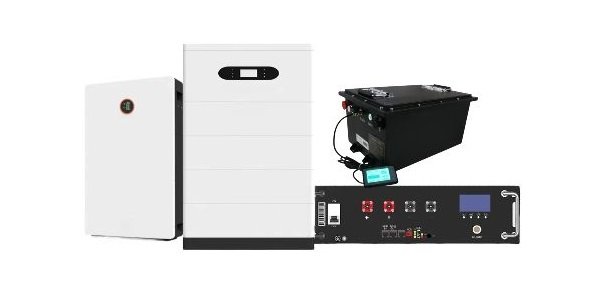
For residential energy storage, people are more likely to choose wall mounted 48V lithium battery, which is installed onto the wall by extra brackets.
For communication station or industrial ess, there is usually server rack mounted 48V lithium battery, of 3U or 4U module.
For golf carts or RV, it will be another kind of iron box, which can be customized with display, wires, plug-in, and handles.
The battery dimension and weight need to be suitable for installing space and cost-saving.
3. Factors for Making Final Decision between Various Brands
There are so many factories and companies providing lithium batteries on this market, but quality and service vary a lot; to find a reliable supplier marks half success for fierce competition.
3.1 Quality and Certificates
In order to catch more chance and save the cost, more and more sellers adopt grade B LiFePO4 cells to make the battery instead of grade A ones; actually the battery performance won’t have big difference for the first two to three years but may vary for the long time operation. Grade A quality indeed has higher price but will be surely a wiser decision for long run business.
Another main factor affecting battery quality is BMS; small-scaled or starting supplier of BMS can’t compete with famous brands like PaceEX, Huasu, which is listed enterprises engaged in energy storage battery BMS.
Last but not the least, batteries inner structure, assembly parts like internal connecting wires, terminals, case and plug-ins also affect its performance and lifespan. Professional manufacturers usually have much more experience to produce high level batteries.
Meanwhile, lithium batteries belong to dangerous products for shipping, which should pass UN38.3, MSDS certifications; and follow this table to see all necessary certificates for selling batteries in different countries:
Region | Certification | Description |
North America | UL Certification | UL1973 and UL9540A for safety and performance standards. |
UN38.3 | Testing for the transport of lithium batteries by air. | |
MSDS | Material Safety Data Sheet | |
Sea Shipping Report | Identification&Classification Report for Transport of Goods | |
European Union | CE | Indicates conformity with EU safety, health, and environmental standards. |
RoHS | Ensures compliance with hazardous materials restrictions. | |
REACH | Registration of chemicals used in the product. | |
UN38.3 | Testing for the transport of lithium batteries by air. | |
MSDS | Material Safety Data Sheet | |
Sea Shipping Report | Identification&Classification Report for Transport of Goods | |
Australia | UN38.3 | Testing for the transport of lithium batteries by air. |
MSDS | Material Safety Data Sheet | |
Sea Shipping Report | Identification&Classification Report for Transport of Goods | |
Africa/Middle East | UN38.3 | Testing for the transport of lithium batteries by air. |
MSDS | Material Safety Data Sheet | |
Sea Shipping Report | Identification&Classification Report for Transport of Goods |
3.2 Lifespan and Warranty
LiFePO4 batteries are tested to have 4000~6000 cycles @ 25℃0.2C discharging, 80% DOD; base on all above factors changes, different batteries may offer shorter or longer life cycles.
Reasonable warranty should include specific conditions of after-sale warranty, for whole battery and for specific parts, which assures the battery quality on one hand but also steady service.
3.3 Price and Service
Till last half of 2024, reasonable price for bulk order LiFePO4 Batteries ranges in $0.095~$0.12/Wh; different models and parameters may have different price but should keep in reasonable changes.
Professional manufacturer should provide consulting, technological communication and support, order negotiation and production process evaluation; when goods ready, all batteries should be arranged for QC testing, aging testing and DG goods examination; all these process should follow local custom rules and assure safety.
4. Conclusion
You should make clear of battery applications to decide on battery type; calculate battery capacity by working current, loading power, operating time and check out BMS parameters, then you can know the ideal model that matches your application; finally choose the right one from professional suppliers with necessary certificates.
The right 48V Lithium Battery will not only helps a lot for successful project but also exceptional performance.