Table of Contents
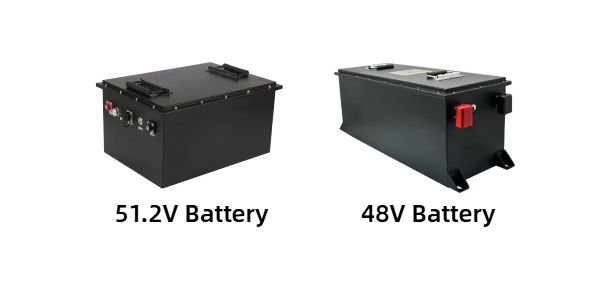
1. Basic Knowledge of 48V&51.2V Golf Cart Batteries
1.1 What Are 48V Golf Cart Battery?
In the traditional method, four 12V lead-acid batteries will be needed to create a 48 volt power system for golf carts. However, this solution is gradually abandoned due to several disadvantages associated with lead-acid batteries:
- Lower Efficiency:Lead-acid batteries typically achieve only around 80% energy transmission efficiency and require frequent recharging to maintain power supply. This performance lags significantly behind newer technologies.
- Safety Risks:The configuration of four batteries necessitates additional cables and connectors for series connection, which can lead to voltage difference during frequent cycling. This situation increases the risk of overcharging and discharging, potentially resulting in fires or explosions.
- Maintenance Issues:Lead-acid batteries demand regular monitoring of electrolyte levels to prevent capacity loss and damage to the plates. Additionally, terminals and connections require routine cleaning to avoid corrosion, and it’s essential to maintain an appropriate operating temperature to prevent gassing and ensure consistent performance.
- Heavy Weight:The bulkiness and weight of lead-acid batteries pose significant challenges for handling and maneuverability in golf carts.
With the advancement of LiFePO4 technology, a more advantageous solution is available in the form of a single 48V or 51.2V LiFePO4 battery.
The benefits of this technology include:
- Higher Efficiency:LiFePO4 batteries can achieve operating efficiencies exceeding 95%, with some premium models reaching up to 98%. It assures in minimal power loss during extended cycling.
- Longer Lifespan:High-quality LiFePO4 batteries typically provide 4,000 to 6,000 cycles with 80% depth of discharge (DoD), and many reputable manufacturers offer warranties up to 10 years.
- Lightweight and Maintenance-Free:LiFePO4 batteries require minimal maintenance, as with stable performance and lighter weight, facilitating easier handling in golf carts.
- Cost-Effective:Industrialized applications of LiFePO4 technology have led to more affordable pricing, making it a cost-effective choice that reduces ongoing maintenance and replacement expenses.
1.2 Voltage and Power Output
- 48V systems: Most traditional golf carts adopt48V batteries, which are the standard power supply for many electric golf carts due to its good balance of power and efficiency.
- 2V systems: 51.2V batteryoffers a higher voltage, of which the slight increase on voltage provides a bit higher power output, leading to potential improvement of acceleration and speed.
1.3 Battery Capacity and Efficiency
- 48V batteries are commonly available in lead-acid or lithium-ion options. Lead-acid batteries have a lower energy density, while lithium-ion batteries can offer better longevity and efficiency.
- 2V batteries are more often in LiFePO4 batteries, typically designed to have higher energy density; you might get more energy at the same weight or a comparable capacity of a lighter weight.
1.4 Motor and Controller Compatibility
For a 48V system, your motor and controller are typically designed to operate within that voltage range. In contrast, 51.2V systems may require different components to handle the higher voltage, which could affect compatibility and performance.
If you want to replace a 48V system by 51.2V battery, you may need to upgrade controllers or motors capable of safely handling the higher voltage.
2. Performance Characteristics
2.1 Power Output
When analyzing the power output of a golf cart battery, several factors should be considered: the battery type, battery voltage, capacity (Ah), motor power, and controller specifications. Let’s break it down step by step to understand how the power output is determined and how it affects the performance of a golf cart.
2.1.1 Power Output Formula:
Power (W)=Voltage (V)×Current (A)
Voltage (V) is the battery discharging voltage level;
Current (A) is max or average working current the battery can provide, which depends on its capacity (Ah) and discharging rate
2.1.2 Battery Voltage and Current (Amp-Hours)
A 48V golf cart typically uses a series of four 12V lead acid batteries in old way setting up a 48 volt power system; the working current of the system depends on the battery capacity(measured in amp-hours), which defines how much current the battery can supply over time. For example, if a battery is rated at 100Ah, it means the battery can theoretically provide 100 amps for 1 hour, or proportionally less current for a longer period (e.g., 10 amps for 10 hours); and max power output is 48V*100A=4800W.
In contrast, 51.2V golf cart is usually composed of a 51.2V LiFePO4 battery; if the battery capacity is 200Ah, and max discharging rate 1C, then its max power output 10240W, which is the maximum power the motor may demands under full load.
2.1.3 Battery Voltage and Current (Amp-Hours)
Motor power dictates how much current is drawn from the battery to produce motion, which is typically rated in kilowatts (kW) or horsepower (HP).
Typical golf cart motors are often in the range of 3KW to 6 KW; for example, a 5KW motor would draw around 100A current at full load on a 48V battery system.
2.1.4 Battery Discharge Rate
How much current does a battery can generate indicates the batteries’ maximum discharge rate, which is usually named as multiple of their capacity rate; for instance: a 200Ah battery with 1C rate could theoretically discharge at 200A for one hour.
If it has 2C rate, the battery could discharge at 400A for 30 minutes.
However, most golf cart batteries especially lead-acid do not discharge at such high rates. Typically, golf carts draw around 50–100A during normal operation, with peaks during acceleration or climbing hills.
2.1.5 Controller Limitation
The controller in a golf cart regulates the flow of electricity between the battery and motor. The controller’s amperage limit often sets a ceiling on how much power the motor can use, even if the battery can supply more.
If a controller is rated for 100A, it allows only up to 100A to the motor, regardless of the battery big discharging rate.
Higher-rated controllers provide more flexibility, particularly in high-performance carts or those with lift kits, bigger tires, or larger motors.
2.2 Efficiency Analysis
Battery efficiency refers to how much a battery can store and release energy to applied devices. This includes the charging&discharging efficiency, and how much energy can be successfully transmitted comparing with lost in heat or other forms of energy.
- 48V battery system (Lead-Acid vs. Lithium-Ion):
Lead-Acid Batteries: Traditional 48V lead-acid batteries have a typical charge/discharge efficiency around 70% to 80%. This means that approximately 20–30% of the energy will be lost in the process;
Lithium-Ion Batteries: 48V lithium-ion batteries have a charge/discharge efficiency of over 90% to 95%. Lithium-ion technology is much more efficient because it has higher energy density and lower internal resistance, largely reducing energy loss during cycling.
- 2V battery system (Lithium-Ion):
LiFePO4 Batteries: A 51.2V LiFePO4 battery will have an even higher charge/discharge efficiency, typically around 95%~98%; the efficiency is relatively higher than 48V lithium-ion battery due to higher voltage level; so the 51.2V LiFePO4 battery will generally be more efficient for most golf carts.
2.3 Battery Range
- 48V Batteries: While they generally provide adequate range for most golf course outings, the distance achievable can vary depending on factors such as the battery’s age, working condition, and driving habits. Over time, performance may decrease as the battery ages, affecting overall range.
- 2V Batteries: Due to their higher energy density and enhanced power management, 51.2V batteries typically deliver greater range compared to 48V systems. The increased voltage allows for more efficient energy use, making them particularly well-suited for longer courses or routes that require more power, ensuring extended use on a single charge.
2.4 Acceleration and Speed
- 48V batteries offer reliable acceleration and a respectable top speed for everyday golf cart operation. They are well-suited for casual driving and typical golf course, providing a comfortable and stable performance for standard outings.
- 2V batteries deliver enhanced acceleration and higher top speed. Thanks to their increased power output., they translate quicker start and a more responsive & dynamic driving experience, making them ideal for greater performance and agility on the course.
3.Battery Life and Maintenance
3.1.1 48V Lead-Acid Batteries:
Typical Lifespan: 3–5 years (with proper maintenance);
Factors Affecting Lifespan: high temperatures, deep discharging, improper charging, long time discharging;
Maintenance: 48V lead acid batteries require regular water refilling (for flooded lead-acid), cleaning, and proper charging practices. Lead-acid batteries tend to lose capacity over time, especially frequent over-discharged situation.
3.1.2 48V Lithium-Ion Batteries:
Typical Lifespan: 7–10 years (depending on use).
Factors Impacting Lifespan: extreme temperature, overcharging, deep discharging, max discharging rate.
Maintenance: minimal care or cleaning compared to lead-acid batteries.
3.2.1 51.2V Lithium-Ion Batteries:
Typical Lifespan: 7–10 years, with some high-quality lithium-ion batteries lasting even longer, especially when used in controlled environments and with proper charging.
Factors Impacting Lifespan: excessive heat, overcharging, and deep discharging. However, lithium-ion batteries have better cycling life compared to lead-acid batteries.
Maintenance: Lithium-ion batteries in the 51.2V system require even less maintenance than their 48V counterparts, as they are self-regulating and typically have built-in battery management systems (BMS) to protect the battery from overcharging, deep discharging, short circuit and other harmful conditions.
4. Physical Factors
4.1 Physical Dimensions
Battery size and weight can significantly impact the overall handling and performance of a golf cart.
- 48V Lead-acid Batteries arebulky and heavy, contributing to an increased overall weight of the cart. This additional weight can affect speed, maneuverability, and overall performance.
- 2VLithium-ion Batteries are typically lighter and more compatible. This reduction in weight enhances the agility of the golf cart, making it easier to removable on course and improving overall performance.
4.2 Handling and Maneuverability
The weight distribution of a golf cart can influence its handling characteristics.
- 48V Batteries: The additional weight can lead to sluggish handling, particularly on tight turns or uneven terrain.
- 2V Batteries: The lighter weight contributes to improved handling and maneuverability, making it for a more enjoyable driving experience, particularly on challenging courses.
5. Cost Analysis
5.1 Upfront Costs
When evaluating battery options, upfront cost is usually a significant consideration.
- 48V Batteries: Generally, lead-acid batteries are more affordable initially. However, their shorter lifespan and higher maintenance costs can add up over time.
- 2V Batteries: Although the initial investment for lithium-ion batteries is higher, their longevity and reduced maintenance needs often make them a more cost-effective solution in the long run; and the mature supply-chain advantages of LiFePO4 technology has widely decreased the production cost for 51.2V LFP batteries especially for golf carts.
5.2 Total Cost of Ownership
- 48V Batteries: The lower upfront cost can be appealing, but ongoing maintenance and replacement costs can make them more expensive over time.
- 2V Batteries: While the initial cost is higher, the extended lifespan and minimal maintenance result in a lower total cost of ownership, making them a smart investment for avid golfers.
6. Environmental Considerations
Environmental impact is an increasingly important factor for consumers.
- 48V Batteries: Lead-acid batteries can have a more significant environmental footprint, as they contain hazardous materials that require careful disposal.
- 2V Batteries: Lithium-ion batteries are generally considered more environment-friendly. Many manufacturers have implemented recycling programs to minimize waste and promote sustainable practices.
7. Conclusion
Choosing between 48V and 51.2V golf cart batteries requires careful consideration of various factors, including performance, efficiency, lifespan, maintenance, and overall costs.
For users who prioritize cost-effectiveness and are engaged in standard golfing activities, a 48V battery may suffice. However, those seeking enhanced performance, longer range, and lower maintenance are strongly recommended for investing 51.2V lithium-ion batteries.
From AK Power, you can get a wide range of high-quality golf cart batteries tailored to meet the diverse needs of golfers. Whether you need standard 48V/51.2V LFP batteries or custom models, we are committed to helping you with satisfactory services.